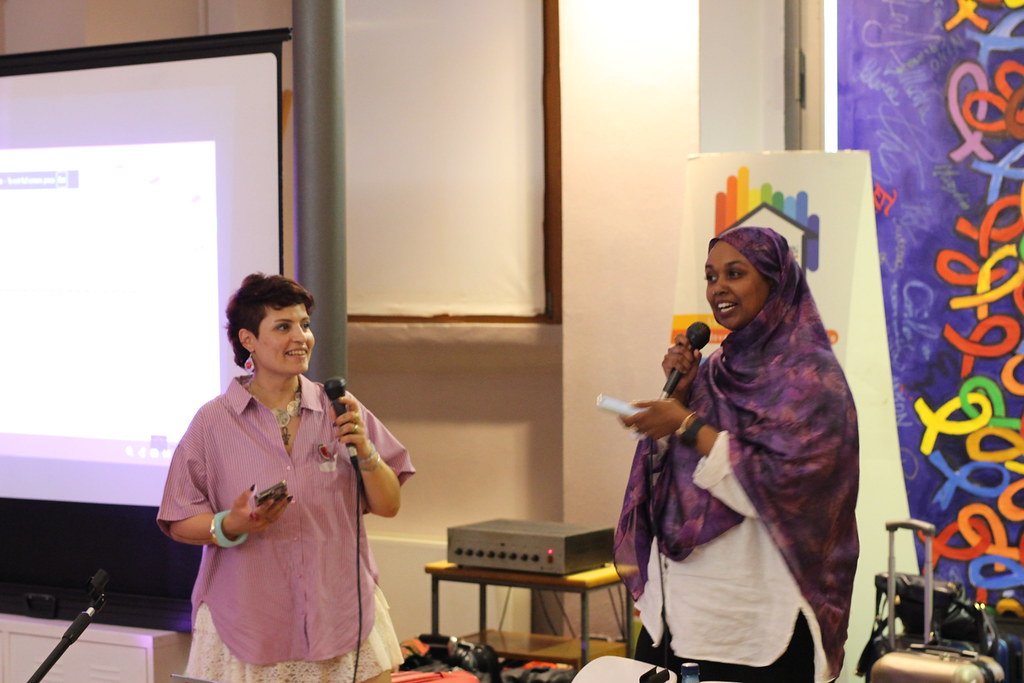
Sana Mariam Alnomeiry
- NAME : Sana Marial
- SURNAME : Alnomery
- PROFILE : Community Expert
- PARTNER : TERRE DE FEMME
Sana Mariam Alnomeiry is a Community Expert in the SAFE project for TERRE DES FEMMES. Having been affected by early and forced marriage (EFM) herself, she brings invaluable lived experience to her work, helping to support women and girls while advocating for lasting change. Learn more about her journey and her work below.
Can you introduce yourself?
My name is Sana (Sana Mariam Alnomeiry). I am an intersectional feminist activist, empowerment trainer, and single mother based in Berlin. My work is not theory—it is lived, political, and rooted in resistance. Grounded in my own experiences, I create spaces where women and girls break silence, reclaim their voice, and are heard, believed, and supported.
How are you involved in the SAFE project?
I am deeply involved in the SAFE project across both community and institutional levels. I facilitate empowerment spaces that are honest, challenging, and necessary — spaces where women and girls can speak without fear of shame, control, or consequences. I name violence clearly—and work collectively to challenge and dismantle it.
Within SAFE, we are also launching professional trainings for practitioners, focused on strengthening discrimination-sensitive, intersectional awareness around female genital mutilation (FGM) and early and forced mariage (EFM). Because real change doesn’t just happen on the margins — it grows when care, awareness, and responsibility reach the spaces meant to protect.
In parallel, I am building empowerment spaces in emergency shelters — intentional, discrimination-sensitive safe(r) spaces where women and girls can break silence and speak about gender-based violence (GBV), including FGM and EFM. These spaces center their voices, acknowledge intersecting realities, and strengthen their agency — where speaking becomes power, and silence is no longer the condition for belonging.
What is one key need you see in the communities you work with?
What I see is not a lack of resilience—it’s a lack of safe, unconditional support. Many women and girls are navigating violence while also being confronted with racism, institutional barriers, and isolation. They are pushed into silence in the name of “family,” and pressured to assimilate in the name of “integration.” Both deny them agency. What is needed are spaces that interrupt this — spaces that are trust-based, discrimination-sensitive, and rooted in dignity, where autonomy is not negotiated but respected.
What is one misconception about FGM or forced marriage that you would like to challenge?
A central misconception is treating FGM and EFM as “cultural problems.” This framing is not neutral—it is racializing, it stigmatizes communities, and it shifts attention away from the structural nature of gender-based violence.
At the same time, avoiding the topic in the name of cultural sensitivity does not protect those affected—it isolates them. I speak about this from lived experience. I have been affected by EFM. I know what it means to have your choices taken from you—and what it takes to reclaim them. That is why I am clear: these practices are not traditions to be respected.
They are systems of control that must be addressed. This work requires both: a firm stance against violence and a refusal to reproduce racism. One cannot come at the cost of the other.
More profile articles
Name Forname Profile article
Et quia Mesopotamiae tractus omnes crebro inquietari sueti praetenturis et stationibus servabantur agrariis, laevorsum flexo itinere Osdroenae subsederat extimas partes, novum parumque aliquando temptatum commentum adgressus. quod si impetrasset, fulminis modo cuncta...
Name Forname Interview
Et quia Mesopotamiae tractus omnes crebro inquietari sueti praetenturis et stationibus servabantur agrariis, laevorsum flexo itinere Osdroenae subsederat extimas partes, novum parumque aliquando temptatum commentum adgressus. quod si impetrasset, fulminis modo cuncta...