SAFE platform
Toolkits to end and prevent female genital mutilation and early and forced marriageSupporting the elimination of female genital mutilation (FGM) and early andforced marriage (EFM) through capacity building and mutual learning.
What are female genital mutilation and early and forced marriage?
Female Genital Mutilation – FGM
Female genital mutilation (FGM) comprises all procedures involving the partial or total removal of the external female genitalia or other injury to the female genital organs for non-medical reasons. It is internationally recognised as a fundamental human rights violation and a form of gender-based violence that primarily affects women and girls, harming their bodily integrity and bodily autonomy.
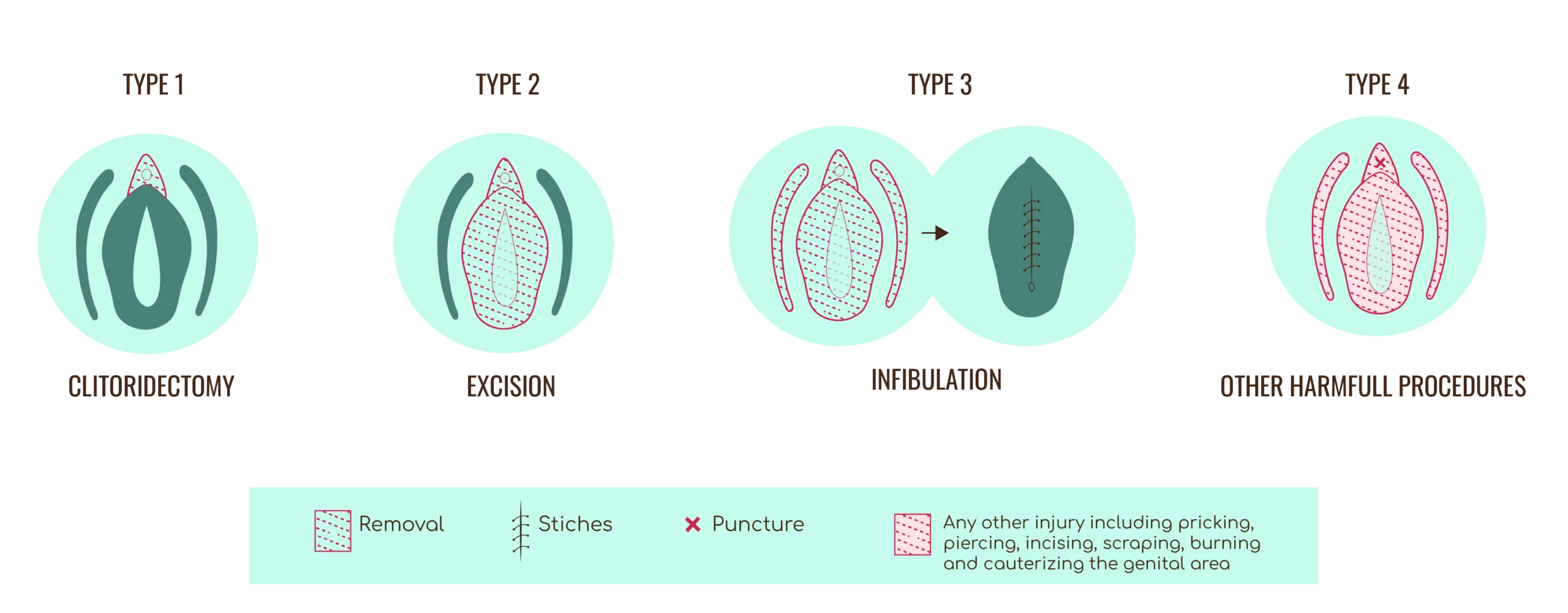
The World Health Organization categorizes FGM into four main types: type 1 (clitoridectomy), type 2 (excision), type 3 (infibulation) and type 4 (all other procedures to the genitalia of women for non-medical purposes).
Female genital mutilation is rooted in gender inequality and unequal power relations between women and men. It reflects deeply entrenched discrimination against girls and women and is used as a means of controlling women’s and girls’ bodies and sexuality. This human right violation is not required by any religion and has no health benefits. Instead, it can result in severe and lifelong physical, sexual, reproductive and psychological consequences, and may even lead to death. Like many forms of gender-based violence, FGM is an expression of patriarchal oppression. Symbolically, female genital mutilation means that individuals, simply because they are born female, are robbed of control over their own bodies.
30 million girls and women alive today have undergone FGM. About 600,000 women and girls are living with the consequences of female genital mutilation in Europe. This form of violence has been reported in at least 94 countries and on every continent except Antarctica.
Prevalence varies significantly between regions, including within countries. Ethnic group and region of origin are determining factors.
The continued existence of female genital mutilation on all continents means that we still live in a world that does not uphold the rights of women and girls.
Early Forces Mariage – EFM
Early and forced marriage (EFM) refers to any formal marriage or informal union in which at least one of the parties is under the age of 18 or where, regardless of age, one or both parties have not given their full, free and informed consent.
Forced marriage is generally viewed as encompassing child and early marriage because minors (under 18 yo) are deemed incapable of giving full and informed consent to marriage under international human rights law.
The number of children who enter into marriage or cohabitation each year varies across countries and over time. Even within a country, prevalence can vary across communities depending on demographic, economic, political, and social factors.
Early/forced marriage can involve threatening behaviour, deception, abduction, imprisonment, physical violence, sexual violence, rape and sometimes murder.
Early and forced marriage is considered a severe violation of human rights and a form of gender-based violence. Although there is a significant lack of reliable statistics (which mostly focus on child marriage and predominantly include girls), it is widely considered that it disproportionately affects girls and women.
Cross-border
A project coordinated by NGOs based in Europe, with a regional focus on France, Germany, Ireland, Italy and Spain.
Community-driven
Community members lead the change together with professionals and organisations.
Empowering
Supporting key professionals and relevant stakeholders through capacity-building.
RESOURCES
Comprehensive Toolkits for everyone
Are you a community member, professional, educator, or advocate looking for resources to support your work to end female genital mutilation and early andforced marriage?
Our toolkits to end female genital mutilation and early and forced marriage exist in different formats and can be used with a variety of audiences.
Download file
Podcast

Video
Quiz
Boardgame
Leaflet
Ready-to-use toolkits against female genital mutilation and early/forced marriage
Available in 5 languages
All SAFE toolkits are available in English, French, German, Italian and Spanish.
Accessible and inclusive design
The SAFE platform and its toolkits follow European accessibility guidelines while promoting a gender sensitive approach.
Created with and for affected communities
The SAFE project is rooted in a community-based approach that involves and empowers affected people as experts in ending female genital mutilation and early/forced marriage.
Latest news
Denique Antiochensis ordinis vertices
Haec subinde Constantius audiens et quaedam referente Thalassio doctus, quem eum odisse iam conpererat lege communi, scribens ad Caesarem blandius adiumenta paulatim illi subtraxit, sollicitari se simulans ne
Retinete igitu est
At nunc si ad aliquem bene nummatum tumentemque ideo honestus advena salutatum introieris, primitus tamquam exoptatus suscipieris et interrogatus multa coactusque mentiri,
Gabinius unus omnium
At nunc si ad aliquem bene nummatum tumentemque ideo honestus advena salutatum introieris, primitus tamquam exoptatus suscipieris et interrogatus multa coactusque mentiri,
Who we are
About SAFE
SAFE (Support Aid FGM EFM) is an EU co-funded project dedicated to tackling female genital mutilation (FGM) and early and forced marriage (EFM) through EU-wide action.
It is led by TERRE DES FEMMES (Germany) together with Akidwa (Ireland), ActionAid (Italy), End FGM EU (European network based in Brussels), Equipop (France) and Save a Girl Save a Generation (Spain).
The SAFE project is co-funded by the European Union
SAFE is a cross-border project involving diaspora communities across Europe, with a focus on France, Germany, Ireland, Italy and Spain.d.
By engaging with communities and policymakers, SAFE aims to drive a lasting change across the European Union.